Report Guide
China Trend Monitor Guide
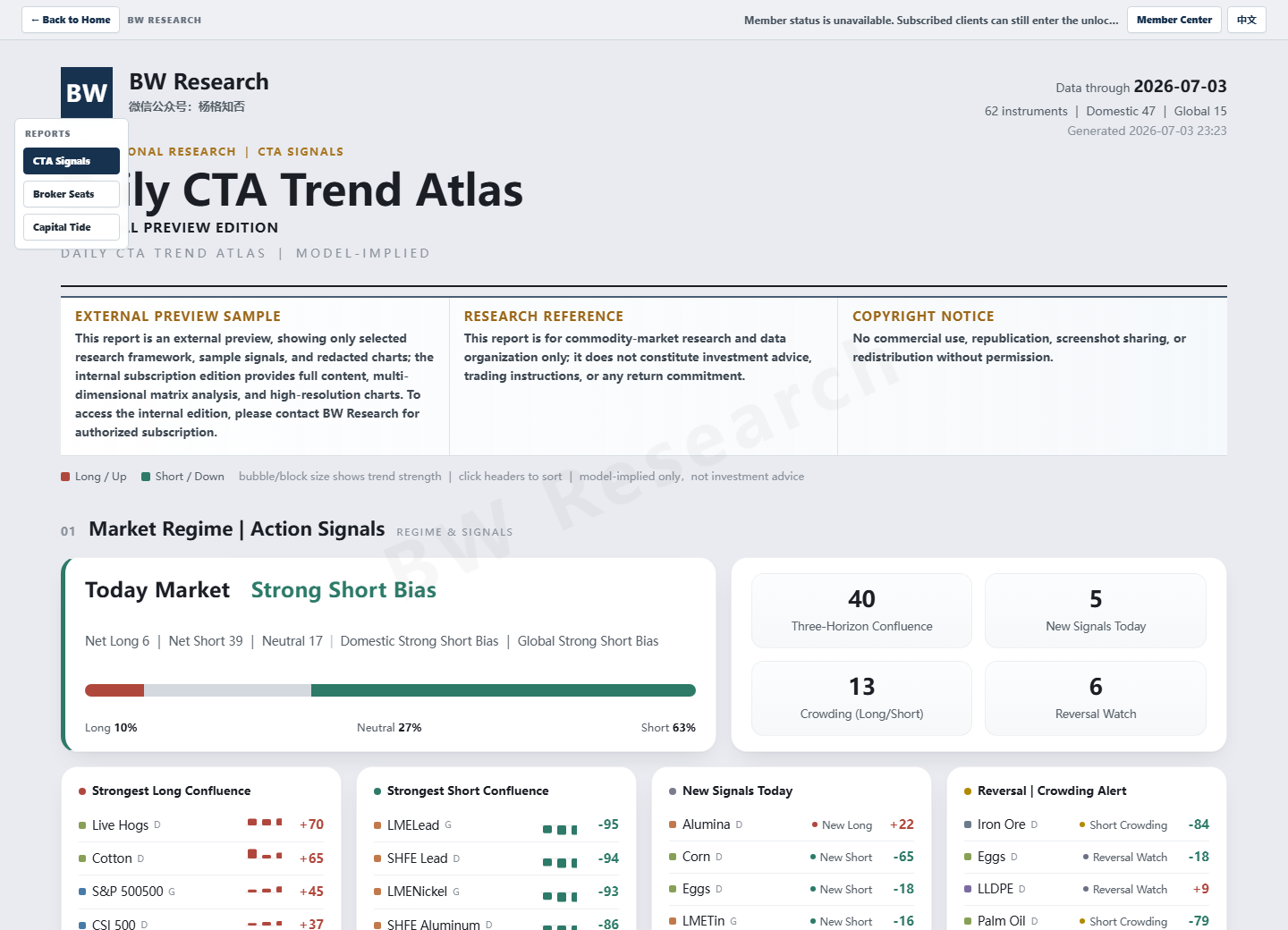
This report is not meant to predict tomorrow's price. It helps you judge whether a tradable trend environment exists, how strong that trend is, and whether the signal deserves follow-up.
01Start With SummaryCheck whether trends are extending, splitting or ranging.
02Compare SectorsSee where trend strength is concentrated.
03Review MatrixConfirm product direction and signal stability.
04Check HistorySeparate new signals from persistent ones.
What it answers
The CTA trend report asks whether the market is trending, weakening, ranging or just entering a watch-list state. It is a trend filter, not a trading instruction.
Core logic
- Trend state: separate directional, weakening, range-bound and watch-list markets.
- Cycle alignment: stronger alignment across cycles usually means better signal stability.
- Sector breadth: sector-level confirmation is more reliable than an isolated product change.
- Historical location: new, accelerating, mature and crowded signals should be interpreted differently.
Suggested reading order
- Check report date, version and headline summary.
- Compare sector strength to see where trend pressure is concentrated.
- Review the product matrix for direction, strength and cycle alignment.
- Use historical snapshots to decide whether signals are new or persistent.
- Put only high-consistency products into the follow-up watchlist.
How to judge signal quality
- Directional consistency across model state, price behavior and cycles.
- Persistence across several sessions rather than a single-day jump.
- Breadth across related products or sectors.
- Confirmation from capital-flow and positioning reports.
How to combine the three reports
- CTA gives direction and trend state.
- China Money Flow gives attention, flow and crowding.
- China Broker Positioning gives positioning structure and divergence.
- When all three confirm each other, priority rises; when they conflict, reduce confidence.
Common mistake
Do not treat a new CTA signal as a direct buy/sell instruction. New signals need confirmation, and strong signals can already be crowded.